


Breast augmentation recovery is different for every patient, which is why there is no one-size-fits-all recovery timeline. At Clareo Plastic Surgery, our breast augmentation recovery recommendations are personalized based on your anatomy, surgical technique, breast implant placement, incision location, lifestyle, and aesthetic goals.
Your plastic surgeon will provide individualized post-operative instructions designed to support proper healing, manage discomfort, and help you safely return to work, exercise, and daily activities. Understanding what to expect after breast augmentation can help you feel more prepared and confident throughout each stage of your recovery.
Breast augmentation can be performed in different ways, including traditional implants, fat transfer, Preservé by Motiva®, or breast augmentation with lift. Each option can affect soreness, swelling, support garments, activity restrictions, and how quickly you return to your normal routine.
TL;DR: After breast augmentation, most patients start with rest, swelling, soreness, and a support bra worn as directed. Short, light walks are usually encouraged early, but heavy lifting, upper-body exercise, and strenuous activity should wait until your surgeon clears them. Your written post-op instructions should guide each step because recovery varies by procedure, anatomy, and healing pattern.

Your procedure type can change your recovery plan
Your recovery plan should match the way your breast augmentation is performed. Implant-based augmentation, fat transfer, Preservé by Motiva®, and breast augmentation with lift can each affect soreness, swelling, support garments, activity limits, and follow-up care.
Implant-based breast augmentation
With implant-based breast augmentation, early recovery often includes swelling, soreness, chest tightness, and consistent use of a support bra. Implants may sit higher at first before settling gradually as swelling improves.
If implants are placed under the chest muscle, tightness may be more noticeable, and your surgeon may limit lifting, reaching, and upper-body activity early on.
Fat transfer breast augmentation
Fat transfer breast augmentation involves healing in the breasts and in the donor areas treated with liposuction. This can mean swelling, bruising, compression, and activity limits in more than one area while your body recovers.
Preservé by Motiva®
Preservé by Motiva® may be appropriate for patients who want modest, shape-focused enhancement with more preservation of native breast structures. Because the technique is designed to be less invasive than traditional breast augmentation, recovery is shorter than a traditional breast augmentation.
Breast augmentation with lift
A breast lift or breast augmentation with lift may be the better plan when breast position, skin laxity, or nipple placement matters as much as volume. This can affect incision care, swelling, and the overall recovery timeline.

The first 24 to 48 hours are about rest and monitoring
The first day or two after breast augmentation are usually the quietest part of recovery. As anesthesia wears off and swelling begins, you may feel tired, groggy, sore, tight, or chilled.
A few basics matter most during this early stage:
- Have someone drive you home and stay with you for the first 24 hours
- Ask for help with meals, medications, and basic tasks
- Take medications only as prescribed
- Wear your surgical bra or support garment as directed
- Give swelling time before judging your early results
This is also a good time to pay attention to how you feel and write down any questions for your first follow-up visit.

Breast augmentation recovery timeline
A breast augmentation recovery timeline can help you plan, but it shouldn’t be treated as a fixed schedule. Your Clareo surgeon will guide activity changes based on your procedure, incision healing, swelling, comfort level, and overall recovery.
Week 1: Rest, soreness, and support
The first week is usually the most restricted. Swelling, bruising, soreness, and tightness are common, especially when implants are placed under the chest muscle.
Wear your surgical bra or other support garment as directed, take short walks, and avoid heavy lifting or raising your arms too high unless you are cleared to do so.
Weeks 2 to 4: Gradual activity returns
You may feel more comfortable with light daily activities during this stage. Even so, healing is still underway, and your breasts may still feel firm, swollen, or higher than expected.
Heavy lifting, intense exercise, and upper-body strain should wait until your surgeon approves them.
Weeks 4 to 8: Exercise and routine may expand
Many patients are cleared to gradually resume more normal routines during this window. Swelling often continues to improve, and the breasts may begin to soften and settle into a more natural position.
Cardio, lifting, chest exercises, and high-impact movement should be added carefully and only with guidance.
Months 2 and beyond: Settling, scars, and final shape
The later stages of breast augmentation recovery are usually about refinement. Swelling can continue to fade, implants may continue to settle, and the breasts may feel softer over time.
Incision lines also mature gradually, so your final results should be judged over months, not weeks.

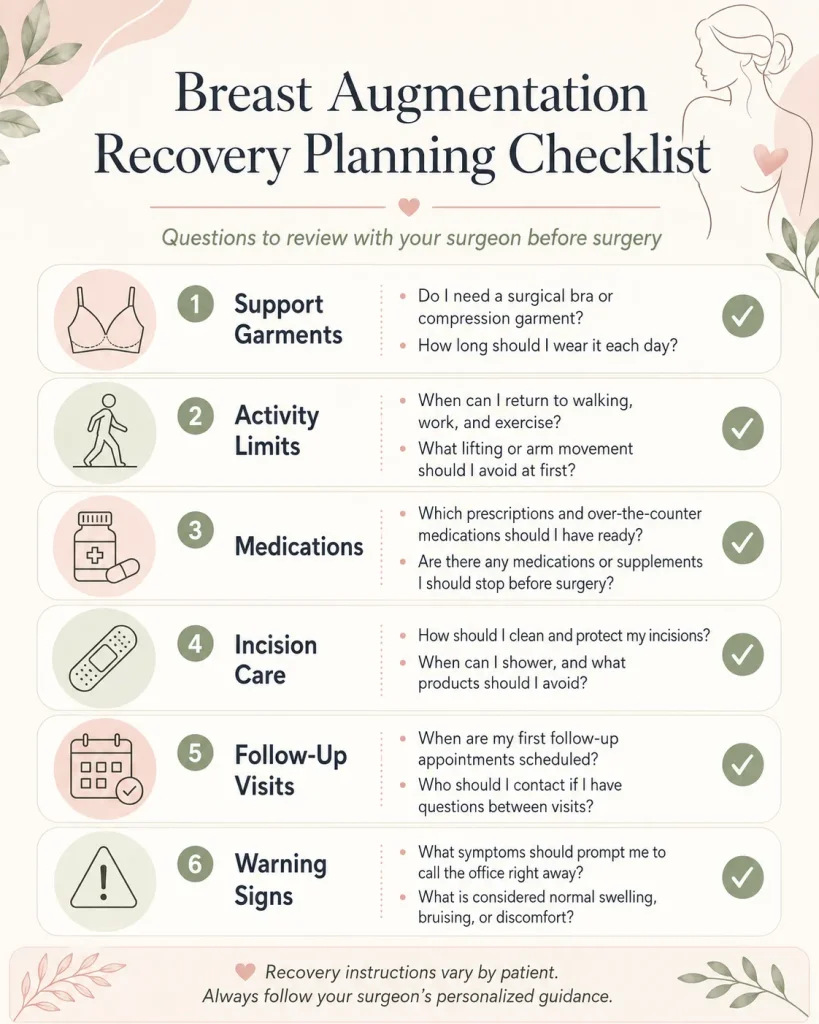
Recovery guidance to confirm before surgery
Before surgery, your recovery plan should be clear enough to follow once you are home. That includes your instructions for incision care, medication use, support garments, activity limits, follow-up visits, and symptoms that should prompt a call.
If your procedure includes implants, your plan should also explain how implant choice, placement, and incision location affect healing, since breast implants are medical devices.
| Question to ask | Why it matters | What to confirm |
|---|---|---|
| What support garment will I wear? | Good support can help reduce strain while swelling improves | How long to wear it and when it can come off |
| What activities should I limit? | Your chest and incisions need time before reaching, lifting, and exercise resume | When you can walk, drive, lift, work out, and use your upper body |
| How should I take my medications? | Clear instructions make pain control safer and easier to manage | What to take, what to avoid, and when to restart regular medications |
| How should I care for my incisions? | Clean, consistent care supports healing and lowers irritation risk | How to shower, manage dressings, and avoid soaking incisions |
| When is my first follow-up visit? | Early follow-up lets your care team check swelling, incisions, and comfort | When to come in and what questions to bring |
| What symptoms should I watch for? | Knowing what is not expected can help you call before a concern worsens | Which symptoms should prompt a call to Clareo |
When to contact Clareo during recovery
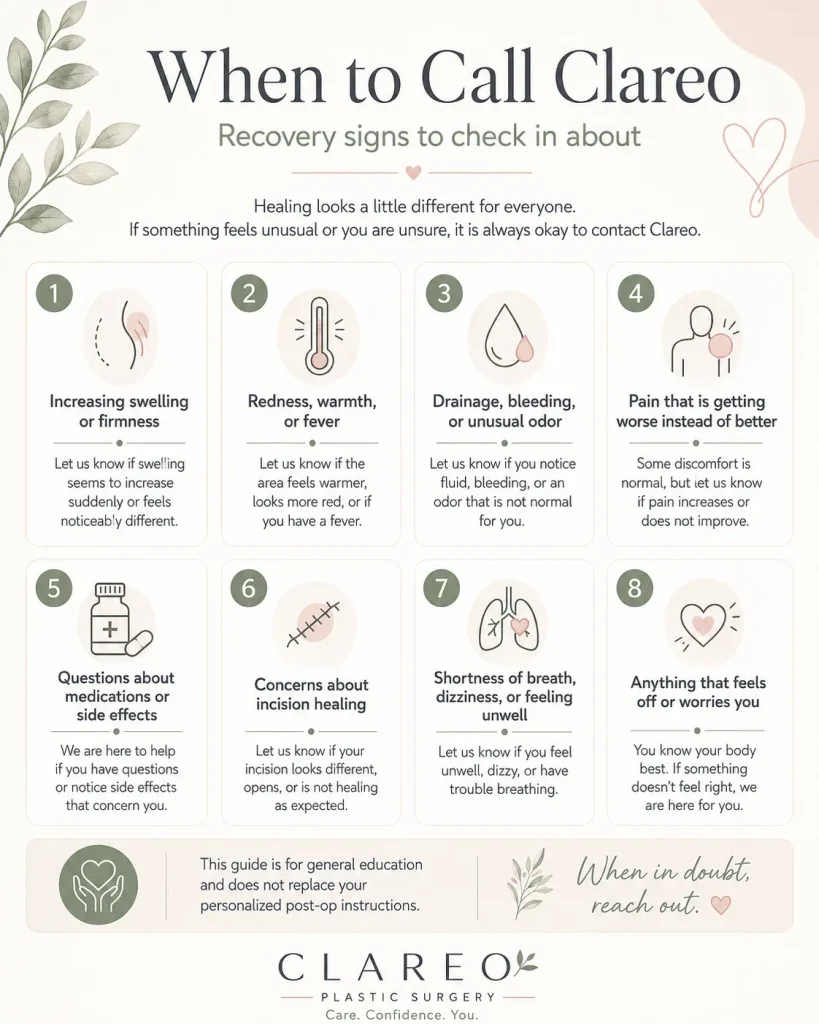
Recovery generally becomes more manageable over time. Some soreness, swelling, bruising, tightness, and temporary sensitivity can be normal, but new or worsening symptoms should be checked.
Contact Clareo if you notice:
- Severe pain that doesn’t improve with prescribed medication
- Swelling that is excessive or noticeably worse on one side
- Fever, chills, or feeling unusually ill
- Increasing redness, warmth, pus-like drainage, or incision opening
- Bright red bleeding that continues to spread
- Rash, itching, or other allergic reaction symptoms
- Sudden firmness, shape change, or concern about asymmetry
What should you do next?
A realistic recovery plan should fit the rest of your life, including work, childcare, exercise, travel, and help at home. That plan may look different for breast augmentation, fat transfer breast augmentation, Preservé by Motiva®, or breast augmentation with lift.
The way recovery looks may also change if your goals involve more than adding volume. When skin laxity, breast position, or nipple placement are part of the concern, a breast lift may affect both the surgical plan and the healing process. Reviewing our breast augmentation before and after gallery can help you compare natural-looking results and think through what feels right for your body.
For procedure-specific recovery guidance, contact Clareo Plastic Surgery online or call (617) 793-7272.
Frequently asked questions
How long does breast augmentation recovery usually take?
Most patients spend the first few days resting, then gradually return to light routines over the following weeks. Swelling, implant settling, scar fading, and final softness continue to improve with time.
What are the most uncomfortable days after breast augmentation?
The first few days are often the most uncomfortable. Swelling, tightness, soreness, fatigue, and limited arm movement are common early on, then recovery tends to feel more manageable.
When can I go back to work?
Many patients return to non-strenuous work within one to two weeks after breast augmentation. Jobs that involve lifting, reaching, carrying, or physical activity may require more time away.
How long should I wear the surgical bra?
Wear your surgical bra for as long as your surgeon recommends. Your instructions may depend on implant placement, incision healing, procedure type, swelling, and how your recovery is progressing.
When can I start exercising again?
Light walking is often encouraged early to support circulation. Cardio, lifting, chest exercises, and high-impact workouts should wait until your Clareo surgeon confirms that your body is ready.
How much swelling is normal?
Swelling is expected after breast augmentation and can take weeks to improve. Swelling that suddenly worsens or appears much stronger on one side should be checked by your surgeon.
When is it okay to sleep on my side?
Plan to sleep on your back during early recovery unless your surgeon gives different instructions. Side sleeping should wait until your breasts, incisions, and implants can tolerate that pressure.
How is fat transfer recovery different?
Fat transfer breast augmentation involves healing in the breasts and in the donor areas treated with liposuction. You may have swelling, bruising, compression garments, and activity limits in multiple areas.
Does Preservé usually mean a shorter recovery?
For the right candidate, Preservé may involve a shorter recovery than traditional breast augmentation. Your timeline still depends on anatomy, implant selection, technique, and your surgeon’s instructions.
When should I call Clareo?
Call Clareo if you notice severe pain, fever, redness, drainage, bleeding, incision opening, sudden firmness, or a major change in breast shape. Swelling that becomes noticeably worse on one side should also be checked.