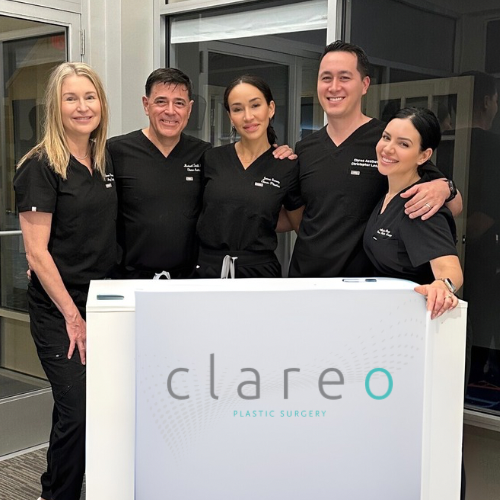






Honest Lee Podcast, Episode 7 | Clareo Plastic Surgery
Quick Answer
Peptides are short chains of amino acids that act as signaling molecules in the body. Some peptide-based medicines have strong clinical evidence and approved indications. Other compounds discussed online—such as BPC-157 and TB-500—remain under active regulatory and scientific review, with limited controlled human evidence for many promoted uses.
Dr. Chris Lee’s bottom line: peptide medicine is not one category. Evidence, regulatory status, product quality and physician oversight all matter.
Key Takeaways
- Peptides are biological signaling molecules, not a single treatment category.
- BPC-157 and TB-500 are being discussed by the FDA’s Pharmacy Compounding Advisory Committee on July 23, 2026, for possible inclusion on the 503A Bulks List.
- FDA review does not establish that a compound is effective for injury recovery, aesthetic improvement or general wellness.
- Tesamorelin has an FDA-approved product history for a defined medical indication; that does not make every wellness use approved or appropriate.
- GHK-Cu must be separated into topical/non-injectable and injectable discussions because the evidence and regulatory considerations are different.
- Unverified online or “research chemical” peptide products create avoidable product-quality and safety risks.
What Is a Peptide?
A peptide is a short chain of amino acids. Amino acids are the building blocks of proteins.
In the body, peptides can act as chemical messengers. They may signal processes involving hormone release, inflammation, tissue repair, metabolism or skin function.
Examples of clinically established peptide-based medicines include insulin and GLP-1 therapies. That matters because it proves the concept: peptide medicines can work when a specific compound is developed, studied, manufactured and prescribed appropriately.
The harder question is not whether peptides can work.
The harder question is whether a specific peptide, for a specific use, has enough reliable evidence and safe access to justify treatment.
Peptide Evidence at a Glance
| Compound or Category | Why It Comes Up | Current Evidence Position | Practical Takeaway |
| BPC-157 | Frequently discussed for tissue healing and recovery | Human efficacy and safety data remain limited for many promoted uses; FDA advisory review is scheduled for July 23, 2026, regarding 503A compounding consideration | Do not treat online claims as clinical proof |
| TB-500 | Often discussed alongside BPC-157 for wound or tissue repair | FDA materials identify limited human safety information and potential concerns involving impurities and immunogenicity; FDA advisory review is scheduled for July 23, 2026 | Sourcing and evidence both matter |
| Tesamorelin | Growth-hormone-releasing hormone analog | An FDA-approved tesamorelin product exists for reduction of excess abdominal fat in adults with HIV-associated lipodystrophy; broader wellness use is a separate question | Approved history is meaningful, but indication matters |
| Ipamorelin | Often discussed in GH-related peptide combinations | Dr. Lee discusses it in the context of his personal regimen; it should not be interpreted as universally appropriate or equivalent to an approved wellness treatment | Requires physician evaluation |
| GHK-Cu, topical or non-injectable | Discussed for skin support and post-procedure protocols | Non-injectable GHK-Cu is listed by FDA as Category 1 under evaluation for 503A compounding; topical literature is more developed than injectable use | Topical and injectable use are not the same discussion |
| GHK-Cu, injectable | Discussed online as a more intensive protocol | FDA materials identify concerns involving potential immunogenicity and limited human safety data for injectable compounded products | More uncertainty and regulatory complexity |
| GLP-1 therapies | Established example of peptide medicine | Approved therapies with substantial clinical development for defined indications | Proof that peptide medicine can be clinically meaningful when properly studied |
The Regulatory Update Patients Should Understand
As of June 2026, the regulatory conversation is active, but it is not a blank-check approval of wellness peptides.
The FDA has scheduled a Pharmacy Compounding Advisory Committee meeting for July 23–24, 2026. On July 23, the committee is scheduled to discuss BPC-157-related bulk drug substances and TB-500-related bulk drug substances for potential inclusion on the 503A Bulks List.
That means these compounds are being reviewed for a compounding pathway. It does not mean they have been proven effective for the recovery, aesthetic or wellness claims commonly made online.
GHK-Cu follows a different track. FDA materials updated in May 2026 list GHK-Cu, except for injectable routes of administration, in Category 1 as a substance under evaluation. FDA stated that it intends to consult the Pharmacy Compounding Advisory Committee regarding potential inclusion of GHK-Cu on the 503A Bulks List before the end of February 2027.
Plain-language takeaway:
- BPC-157 and TB-500: scheduled for FDA advisory review in July 2026.
- Non-injectable GHK-Cu: under evaluation on a separate timeline.
- Injectable GHK-Cu: carries separate safety and regulatory concerns.
- Review status is not the same as proven benefit, approval for a promoted use or guaranteed access.
BPC-157 and TB-500: Interesting Does Not Mean Proven
BPC-157 and TB-500 are frequently discussed as “healing peptides.”
The interest is understandable. The underlying biological theories involve pathways relevant to tissue repair, inflammation and wound response.
The limitation is also clear: promoted claims have moved faster than controlled human evidence.
For patients, the clinically responsible position is straightforward:
- Animal or laboratory evidence can justify research interest.
- Anecdotes can raise questions worth studying.
- Neither replaces controlled human evidence.
- A product purchased online cannot be assumed to contain the stated ingredient, concentration or sterility.
Dr. Lee’s position in Episode 7 is not dismissal and not hype. It is caution: these compounds may be worth studying, but the evidence and sourcing questions remain central.
Tesamorelin, Ipamorelin and Dr. Lee’s Personal Experience
In the episode, Dr. Lee discusses his personal use of tesamorelin and ipamorelin. He reports early observations involving sleep continuity, workout recovery and heart rate variability.
He is also clear about the limitation: this is an early, single-person observation. It is not a clinical trial and should not be treated as proof of effectiveness for another person.
Why does tesamorelin stand out in the discussion?
Tesamorelin has an FDA-approved product history. EGRIFTA WR is an FDA-approved tesamorelin product for reduction of excess abdominal fat in adult patients with HIV-associated lipodystrophy.
That approval history provides a defined clinical and safety framework for an approved indication. It does not establish that tesamorelin, alone or combined with another compound, is appropriate for general recovery, anti-aging or performance goals.
Patients considering GH-related therapies should discuss:
- Their actual symptoms and treatment goals
- Relevant laboratory evaluation
- Contraindications and monitoring
- Approved versus off-label use
- Product sourcing and pharmacy quality
GHK-Cu: Why Topical and Injectable Use Must Be Separated
GHK-Cu is a copper-binding peptide discussed in skin care and tissue-repair research.
In Episode 7, Dr. Lee says he uses topical GHK-Cu personally and incorporates it clinically in post-procedure skin-care conversations.
The key distinction is route of administration.
Topical or Non-Injectable GHK-Cu
- Has a more developed skin-care evidence discussion than many wellness peptides
- Is being evaluated separately by FDA for compounding consideration
- Can be discussed as a topical skin-care ingredient without assuming injectable safety
Injectable GHK-Cu
- Raises different manufacturing, sterility and immune-response questions
- Has less reassuring human evidence than topical use
- Should not be presented as equivalent to a topical serum
The clean takeaway: a topical skin-care ingredient and an injectable compounded product are not interchangeable simply because they share the same peptide name.
GLP-1 Therapies: The Proof of Principle
One of the most important points in Episode 7 is also the simplest: peptide medicine is already part of modern clinical care.
GLP-1 therapies demonstrate that a peptide-based medication can produce meaningful outcomes when it has:
- A clear mechanism
- Controlled clinical development
- Defined indications
- Regulated manufacturing
- Medical monitoring
That does not validate every peptide promoted online.
It sets the standard every peptide claim should be measured against.
Why Sourcing Matters as Much as the Compound
A compound name is not enough.
When a patient buys an injectable product from an anonymous website, an overseas vendor or a seller labeling it “not for human use,” the patient may not know:
- Whether the vial contains the stated ingredient
- Whether the concentration is correct
- Whether sterility standards were followed
- Whether contaminants or impurities are present
- Whether the product was stored or shipped correctly
For any legally prescribed compounded therapy, Dr. Lee emphasizes a higher standard:
- Physician evaluation
- A properly licensed pharmacy operating within applicable law
- Clear product documentation
- Appropriate batch-quality information when available
- Clinical monitoring rather than self-directed online protocols
The practical rule is simple: do not inject a product you bought from an unverified source because a social-media thread or influencer protocol made it sound safe.
What Dr. Chris Lee Personally Uses
In Episode 7, Dr. Lee describes his own current position:
- Topical GHK-Cu: He uses it personally and discusses it in clinical post-procedure skin-care protocols.
- Tesamorelin and ipamorelin: He reports recently starting this combination and tracking early personal observations.
- BPC-157: He describes it as scientifically interesting but says he has not personally injected it, in part because of sourcing concerns.
This is not a universal treatment recommendation.
It is a physician’s explanation of how he separates personal use, clinical evidence, regulatory status and product-quality concerns.
Peptide Safety Checklist
Before considering a peptide-related treatment discussion, ask:
- What is the specific treatment goal?
- Is the use supported by human clinical evidence?
- Is the product approved for this indication, under evaluation or investigational?
- Is the treatment being supervised by a qualified physician?
- Is the pharmacy legally permitted to provide the product?
- Is there reliable product-quality documentation?
- What monitoring is required?
- What are the alternatives with stronger evidence?
Frequently Asked Questions
Are peptides real medicines?
Some are. Insulin and GLP-1 therapies are examples of peptide-based medicines used in clinical care. Other peptides discussed online have far less evidence for the uses being promoted.
Is BPC-157 FDA approved for injury recovery?
No approved injury-recovery indication is established in the FDA materials discussed here. BPC-157-related substances are scheduled for FDA advisory committee discussion on July 23, 2026, regarding possible inclusion on the 503A Bulks List.
Is TB-500 proven for healing injuries in humans?
Human evidence remains limited for the claims often made online. FDA materials also identify safety-information gaps and potential risks involving compounded products.
Is tesamorelin FDA approved?
An FDA-approved tesamorelin product, EGRIFTA WR, exists for a defined indication involving excess abdominal fat in adults with HIV-associated lipodystrophy. That approval does not automatically apply to general wellness or recovery use.
Is topical GHK-Cu the same as injectable GHK-Cu?
No. Route of administration changes the evidence, safety and regulatory discussion. Topical and injectable use should be evaluated separately.
Should I buy peptides online?
Unverified online products create avoidable risks involving identity, concentration, sterility and contamination. A treatment discussion should begin with a qualified physician, not an anonymous seller.
The Bottom Line
Peptides are not miracle medicine. They are not all hype either.
They are a broad class of signaling molecules with very different levels of evidence, different routes of administration and different safety questions.
The most responsible path is not to follow an online protocol. It is to understand:
- What is known
- What is unproven
- What is legally accessible
- What product quality can be verified
- What a qualified physician recommends for your specific situation
Schedule a consultation with Clareo Plastic Surgery
Medical Disclaimer: This article is for educational purposes only and does not provide personal medical advice, diagnosis or treatment. Regulatory status, availability and clinical evidence may change. Speak with a qualified physician about your individual medical history, goals and treatment options.
References for Publication
- U.S. Food and Drug Administration. July 23–24, 2026: Meeting of the Pharmacy Compounding Advisory Committee.
- U.S. Food and Drug Administration. Bulk Drug Substances Nominated for Use in Compounding Under Section 503A of the Federal Food, Drug, and Cosmetic Act. Updated May 14, 2026.
- U.S. Food and Drug Administration. Certain Bulk Drug Substances for Use in Compounding that May Present Significant Safety Risks. Content current as of April 22, 2026.
- U.S. Food and Drug Administration. EGRIFTA WR prescribing information, tesamorelin for injection.